
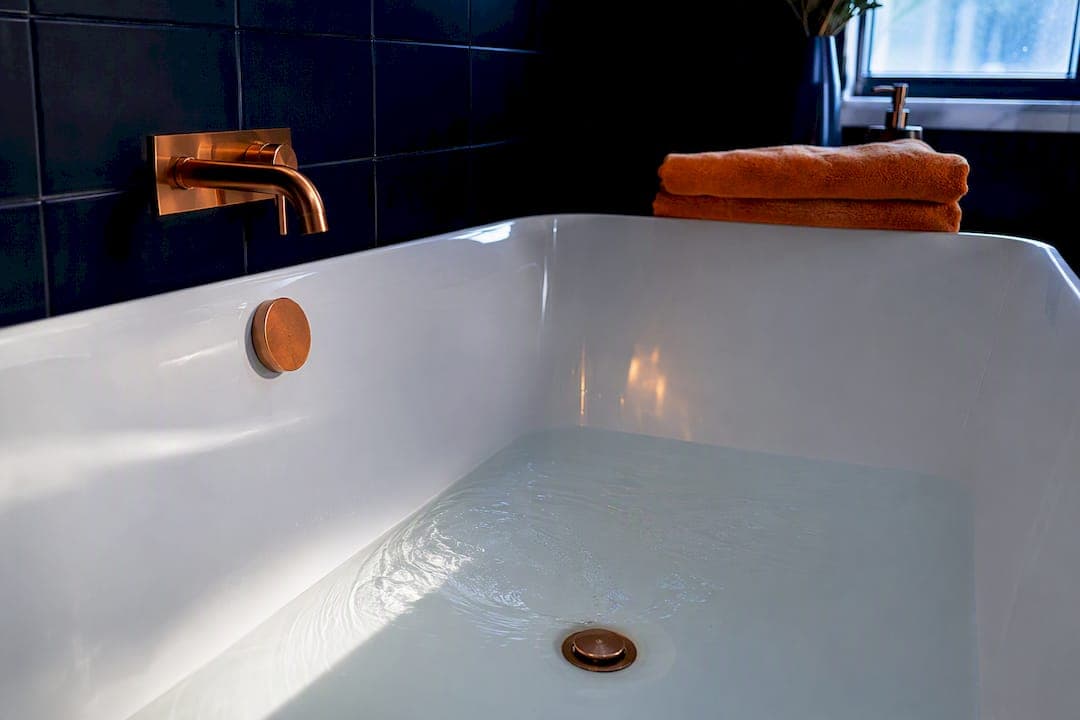
Most baths that won't drain are blocked by hair and soap scum near the plughole, not a deep pipe fault. Clear visible hair by hand, then try a plunger with the overflow sealed, or flush with very hot water. If the water still won't shift after that, move to a drain snake, or call a professional like Sussex drain ltd rather than reaching for chemical unblockers.
TL;DR:
- Most bath blockages are caused by hair and soap scum accumulation near the plughole, which can often be cleared manually or with plunging.
- Hard water regions accelerate pipe narrowing through limescale buildup, making clogs form and worsen faster.
- For deeper or composite blockages, mechanical tools like drain snakes or CCTV inspections are more effective than chemical unblockers.
- Calling a professional is recommended if multiple fixtures backup, foul odors persist, or repeated DIY attempts fail within a few weeks.
- Regular use of hair traps and avoiding disposal of wipes or oils can prevent recurring drainage issues.
Table of Contents
- Why is my bath not draining? Common causes explained
- What to try first for a slow bath drain
- How do you clear a blocked bath drain manually?
- When should you call a professional instead of DIY?
- How to stop your bath drain blocking again
- What experience backs this advice?
- A note on doing this safely
- Get a professional fix for a bath that won't drain
- Sources
Why is my bath not draining? Common causes explained
Hair and soap scum are the double act behind most bathtub blockages. Loose hair catches on the crossbars of the plughole strainer, and soap scum (the fatty residue left when soap reacts with minerals in water) glues itself to that hair, building a mat that shrinks the opening a little more with every wash. Checkatrade lists this combination alongside hard-water deposits, foreign objects, and faulty stoppers as the primary causes of a blocked bath drain, and if clearing the plughole itself doesn't restore flow, the obstruction has probably moved further down the pipe.
Hard water areas add a second layer to the problem. Limescale, the chalky mineral deposit left behind as hard water evaporates, narrows pipe diameter over time and roughens the internal surface, which gives hair and grease even more to grip onto. That's why a bathtub not draining in a limescale-heavy region often gets worse faster than the same blockage would elsewhere.
You can usually tell how deep a clog sits by watching how the water behaves.
- Water clears the plughole area but pools ankle-deep and drains at a crawl: the blockage is likely in the trap or the first stretch of pipe.
- Gurgling noises after you pull the plug: air is trapped behind an obstruction further along the branch pipe.
- Other fixtures (the sink, the toilet) start backing up when you run the bath: the blockage sits deeper in the shared drainage system.
- Standing water that barely moves after ten minutes: a near-total blockage, not a slow bath drain issue.
Composite blockages don't just slow water down, they compound. Once hair and soap scum bind together, mechanical extraction becomes far more effective than chemical dissolvers alone, because the fibres physically resist being dissolved. That's the whole logic behind trying a hook or snake before you touch anything from under the sink.
What to try first for a slow bath drain
Work through these in order. Most slow-draining bathtub problems resolve at step two or three, before you ever need tools.
- Pull out visible hair and gunk by hand. Wear rubber gloves, reach into the plughole, and lift debris out rather than pushing it down. Pushing a clog deeper is the single most common mistake people make here.
- Plunge the bath properly. Fill the tub with a few centimetres of water so the plunger has something to push against, then seal the overflow hole with a wet cloth or duct tape. Sealing the overflow is essential, because otherwise plunger pressure just escapes through that gap instead of hitting the clog. Give it 10 to 15 firm plunges, check for movement, and repeat once or twice more if needed.
- Flush with very hot water. Boiling water straight from the kettle is fine for metal pipework, but if your bathtub runs into plastic (PVC) waste pipes, use very hot tap water instead. Boiling water can soften or warp plastic joints over repeated use.
- Try bicarbonate of soda and vinegar. Pour around half a cup of bicarbonate of soda down the plughole, follow with half a cup of white vinegar, and leave it to fizz for 15 to 30 minutes before flushing with hot water. This loosens soap scum and light grease but rarely shifts a solid hair mat on its own.
Pro Tip: Do this method twice, a week apart, if your bath drains slowly rather than being fully blocked. Bicarbonate and vinegar work on residue buildup, not on a single deep clog, so repeated light treatments beat one big dose.
Skip shop-bought chemical drain unblockers if you can. They're caustic, they can damage older or plastic pipework, and they're genuinely dangerous if any residue mixes with another cleaning product. Mixing bleach with ammonia-based or acidic cleaners can release toxic gas, so never layer one chemical treatment on top of another, and always ventilate the bathroom if you do use one.
How do you clear a blocked bath drain manually?
When hand-clearing and plunging haven't worked, it's time for the mechanical tools that actually reach the clog. Gather a drain snake or plumber's auger, a flat-head screwdriver, gloves, and a torch before you start.
- Remove the overflow cover first, not the plughole strainer. Unscrew the overflow plate below the taps and pull the linkage rod through gently. Many bath blockages sit closer to the trap when accessed via the overflow than when you try to force a tool straight down the visible plughole, and this route avoids damaging the fitted waste assembly.
- Feed the drain snake through the overflow opening. Push the cable in slowly until you feel resistance, then rotate the handle steadily rather than forcing it forward.
- Retrieve slowly. Pull the cable back out in short tugs so any hair or debris caught on the end doesn't slip off halfway.
- Repeat from the plughole if the overflow route doesn't reach the clog, using the same slow, rotating motion.
A straightened wire coat hanger with a small hook bent into the end works for near-surface hair, and it costs nothing if you don't own a snake. It won't reach anything beyond the trap, though, and a sharp hook risks scratching enamel baths if you're not careful with the angle.
- Stop if you feel hard resistance that doesn't give after two or three attempts. That's usually a fixed obstruction, not soft debris.
- Stop if water backs up faster than before you started. You may have pushed the clog into a narrower section of pipe.
- Watch for foul smells returning within days of clearing the surface. That points to a deeper problem than surface hair.
Pro Tip: If the snake keeps hitting the same spot at roughly the same distance every time, that's usually a fixed joint or root ingress, not loose debris. Repeated attempts at that point risk cracking older ceramic or clay pipework.
Mechanical clearance resolves most early and mid-stage blockages without any chemical risk, which is exactly why it's worth trying before anything else. Past that point, you're looking at a CCTV survey to see what's actually happening inside the pipe.
When should you call a professional instead of DIY?
Give yourself one focused attempt at the steps above, not repeated sessions spread across a weekend. If the bath is still not draining, or the same slow drain comes back within a week or two of "fixing" it, that recurrence is the signal to call someone in rather than keep escalating.
A few symptoms point straight past DIY territory:
- Multiple fixtures backing up together (bath, sink, and toilet all slow at once).
- Persistent foul odours that return even after cleaning the trap.
- Damp patches or smells appearing near external walls close to the bathroom.
- A drain snake meeting the same hard resistance repeatedly at a fixed distance.
CCTV inspection is the reliable way to tell a removable organic blockage apart from a structural fault like root ingress or a collapsed joint, and it saves you paying for repeat call-outs that never solve the actual problem. When you do call a plumber or drainage specialist, have this ready: what you've already tried, roughly how long you spent on it, and any visible signs (smell, gurgling, water colour) you noticed along the way. High-pressure jetting and pipe relining both follow from what the survey finds, not before.
How to stop your bath drain blocking again
A hair trap over the plughole is the single cheapest fix available, and emptying it after every bath (not once a week) is what actually keeps it working. Most traps cost very little and fit straight over an existing strainer without tools.
- Empty the hair trap after every bath, not on a weekly schedule.
- Run a quick visual check weekly and do a bicarbonate-of-soda treatment monthly in hard-water areas.
- Never pour wipes, cotton buds, or bath oil residue down the plughole.
- Flush with hot water straight after using bath oils or bombs, since these leave a waxy film that hardens as it cools.
- Book a professional clean every year or two if you're in a hard-water region or have an older property with original pipework.
Pro Tip: If you use bath bombs or oils regularly, that waxy residue is often the real reason behind a slow bath drain that "just started" a few weeks later. It builds silently and only shows up once it's thick enough to catch hair.
What experience backs this advice?
Sussex drain ltd works blocked and slow-draining baths across East and West Sussex every week, and the pattern rarely changes: most call-outs start with a homeowner who's already tried a plunger and bicarbonate of soda, and the fix turns out to be a hair mat sitting just past the trap. Occasionally it's something bigger.
One recurring case type: a bath drains slowly for months despite repeated DIY clearing, until a CCTV survey reveals root ingress several metres down the branch pipe, invisible from the plughole and untouched by any amount of plunging.
What guides the approach on every job:
- 24/7 availability with a genuine 60 to 90 minute response window for emergencies.
- Transparent, itemised pricing agreed before work starts, with no hidden extras.
- Mechanical clearance and CCTV diagnostics tried first, chemicals only where genuinely appropriate.
- Services ranging from emergency unblocking to pre-purchase CCTV surveys for homeowners, landlords, and letting agents.
A note on doing this safely
We'd rather talk someone through pulling hair out of a plughole for free than send an engineer out for something a wet cloth and a plunger could fix. Mechanical clearance comes first on every job because it's kinder to old pipework, and chemicals only get considered once we've ruled out a physical clog a snake can reach. A same-day visit usually includes a CCTV check if the blockage isn't obvious from the surface, so we're not guessing twice. Before we arrive, clear access to the bathroom and have a rough idea of how long the problem has been going on. It saves everyone time.
— Nathan
Get a professional fix for a bath that won't drain
Sussex drain ltd clears the blockages a plunger and bicarbonate of soda can't reach, and does it with a fixed, itemised price agreed before any work starts, not a vague estimate that grows once the van's on the drive.
If you've worked through the DIY steps above and the bath is still holding water, or the slow drain keeps coming back, that's exactly the point to bring in a specialist. Sussex drain ltd offers emergency drain unblocking with a 60 to 90 minute response window across East and West Sussex, alongside CCTV drain surveys for anything that looks like it sits deeper than a hair clog. High-pressure jetting and repairs follow directly from what the camera finds, so you're never paying for guesswork.
Before you call, jot down what you've already tried and roughly how long the problem's been going on. It helps the engineer diagnose faster on arrival. Get in touch with Sussex drain ltd today to book a same-day visit and see the fixed price before anyone lifts a tool.